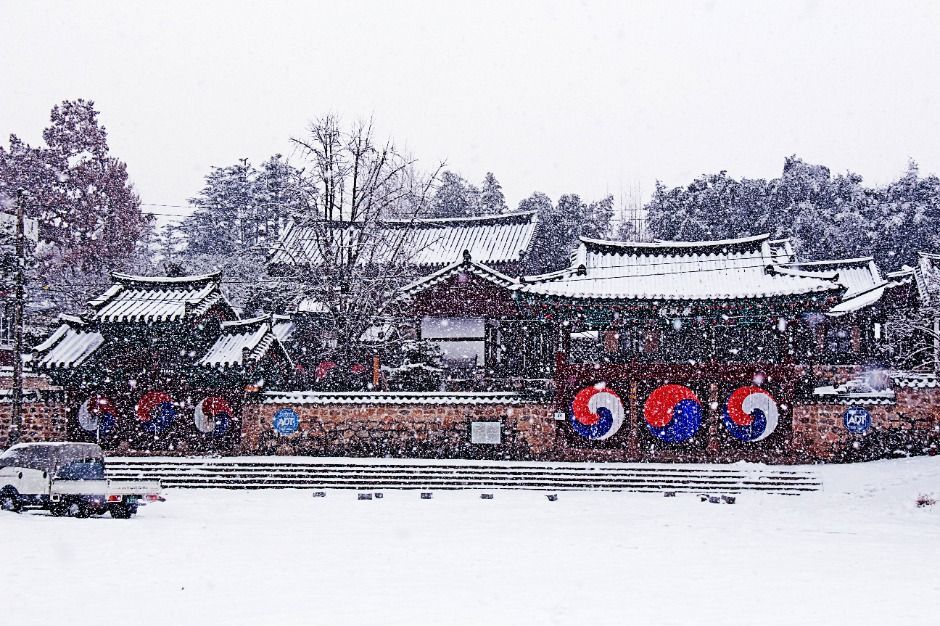
Geochang Hyanggyo
📍 34 Seongsan-gil, Geochang-eup, Geochang-gun, Gyeongsangnam-do
🕐 Hours: Open all year round / Closed: None (open all year)
About this place
It was founded in 1415 to enshrine and venerate the ancestral tablets of virtuous scholars, and to provide secondary education and moral enlightenment for the local people. Subsequently, the Daeseongjeon Hall was established, and it was rebuilt by Magistrate Seo Ui in 1572. In 1574, Magistrate Jang Mun-han constructed the Myeongnyundang Hall. It was later destroyed during the Imjin War, but the Daeseongjeon Hall was rebuilt in 1623, and in 1714, Magistrate Kim Si-bin built the Chunpungnu Pavilion in front of the Daeseongjeon Hall. In 1748, Doyusa Kim Cheon-bun relocated it to its current location, and in 1809, Doyusa Lee Sang-jo rebuilt it. In 1840, Doyusa Lee Jun-ok, along with incumbent Byeon Yun-seok and Eo Jae-ui, consulted to renovate the Dongjae and Seojae Halls, and in 1799, Deputy Magistrate Lee Seong renovated the Dongmu and Seomu Halls. Subsequently, the property of the Hyanggyo was transferred to the Hyanggyo Foundation under a military government decree in 1948, and as the fields and farmlands were distributed under the Land Reform Act of 1950, the site continued to fall into disrepair. However, reconstruction and repairs began in 1974 in accordance with the Hyanggyo organizational system, and it was fully restored in 1976. During the Joseon Dynasty, the state provided fields, slaves, and books for instructors to teach students; however, currently, its educational function has ceased, and the Seokjeon ceremony is held in the spring and autumn, with incense burning on the first and fifteenth days of the lunar month.
Source: Korea Tourism Organization
Based on public data and may differ from reality — please check before you visit.