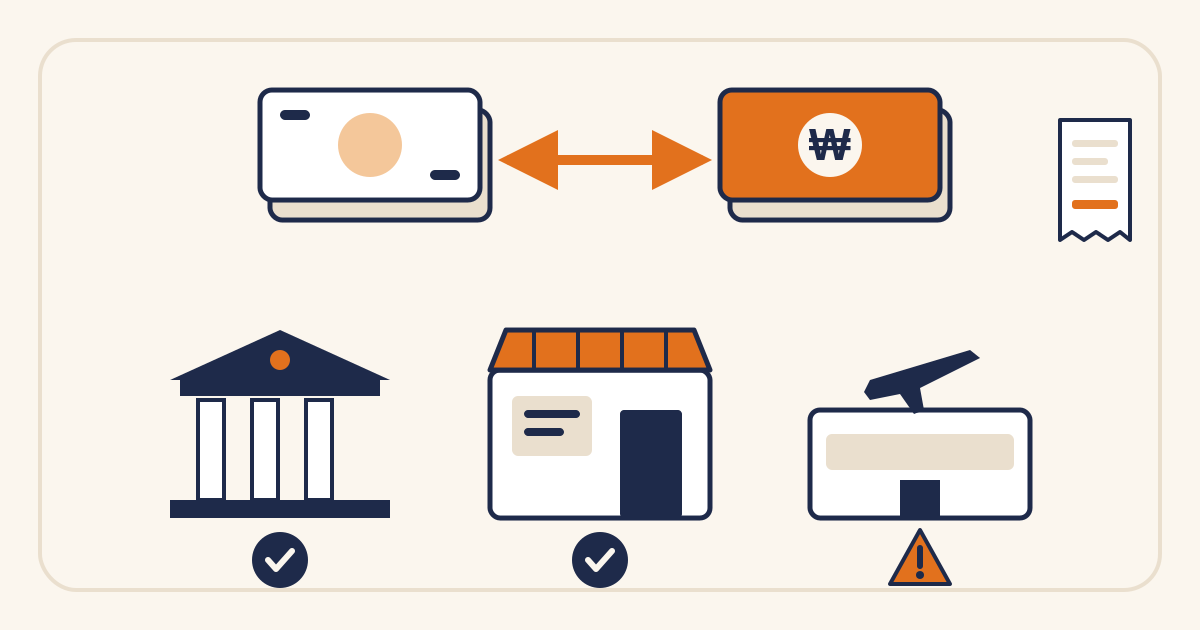
Reading the rate board — base rate and spread
A bank’s rate board usually shows a base rate, a cash buying rate, a cash selling rate, and rates for sending and receiving transfers. The base rate is the reference midpoint; the rate you actually get is always less favourable. That gap is called the spread, and it is how banks and exchange offices make money.
An advert promising a “90% rate discount” does not mean the rate itself is cut by 90%; it means the spread — the fee part — is reduced by that much. So rather than looking only at the discount figure, compare the final amount you pay and the amount you receive.
Rates change several times a day. If you plan to exchange a large sum, you can watch the trend for a few days and exchange in smaller portions. You can also check today’s rate on K-lifeon’s exchange-rate screen.
Where to exchange — comparing the options
Bank branches are the most trustworthy, but without a discount their rates are not especially good. Ordering currency in a bank app and picking it up at a chosen branch or airport branch often comes with a better discount, which is handy when you know your plans in advance.
Exchange offices in tourist areas must be registered with the Korea Customs Service, and registered shops usually display their certificate. Some offer better rates than banks, but they vary a lot, so compare two or three and always get a receipt. Airport counters are convenient but tend to have poorer rates, so exchange only enough for your first day’s transport and meals there.
The condition of foreign banknotes matters too. Torn notes, notes with writing on them, or very old designs may be refused or given a lower value. Flatten and sort your notes before exchanging, and count the won you receive at the counter before you walk away.
| Place | Pros | Watch out for |
|---|---|---|
| Bank branch | Safe, with a proper receipt | Average rate without a discount; limited opening hours |
| Order in a bank app, collect later | Often a bigger discount | You must collect at the chosen branch and by the deadline |
| Registered exchange office | Common in tourist areas; some have good rates | Rates vary widely; check the certificate and get a receipt |
| Airport | Available the moment you land | Rates tend to be worse; change only what you need |
| Social media or private deals | None | Risk of fake notes, fraud and breaking the law — do not use |
Thai baht, cards and ATMs
Currencies that are less traded in Korea, like the baht, are not stocked as cash at every bank branch, and their spread is often wider than for US dollars. If you bring baht, compare a few exchange offices that accept it, and work out whether changing to won in Thailand before you leave would give you more.
You can also pay with a card issued abroad or withdraw won from ATMs that accept foreign cards. Fees may be charged by both your own bank and the Korean ATM, so check your card’s terms first. If a card terminal asks whether to charge you in your home currency, paying in Korean won (KRW) is usually the better deal.
Many people use prepaid travel cards that you top up with foreign currency in advance. They are convenient, but the exchange rate applied when topping up, overseas ATM withdrawal fees and where the card works in Korea all vary by card, so check the terms before you leave. If you will live in Korea long term, opening a Korean bank account after alien registration is safer than carrying a lot of cash.
Carrying cash in and out of Korea
When entering Korea, you must declare to customs if the foreign currency, won, cheques and similar you carry add up to more than USD 10,000. Amounts over USD 10,000 must also be declared when leaving, and money declared on arrival can be taken out under that declaration. Failing to declare can lead to the money being seized or to fines and penalties, so check the Korea Customs Service guidance before you travel.
Keep your exchange receipts. When you change leftover won back into foreign currency on departure, you may be asked for them or limited in how much you can change.
Avoiding illegal exchange and scams
Stay away from private deals on social media or in chat groups offering “better than bank” rates. You could receive counterfeit notes, send money to someone who then disappears, or unknowingly be used to launder criminal money and have your account frozen. For the same reasons, avoid people who approach you on the street offering to change money.
Unregistered currency exchange or money transfers abroad — informal “hand-to-hand” remittance — can break Korea’s foreign exchange laws. To send money home, use a bank or a registered remittance company (see our overseas remittance guide). If you have been scammed, contact your bank immediately and report it to the police on 112.