Two kinds of address: road-name and lot-number
Two kinds of address are used side by side in Korea. The official one today is the road-name address, which shows a location by the road name and building number and has been in full use since 2014. The older lot-number address shows the neighbourhood (dong) name and a land lot number, such as “○○-dong 123-4”, and you still often see it on property documents, old signs and when older people give directions.
The two addresses for the same building can look completely different. Use the road-name address on forms as a rule; if you enter either one into a map app or an address search site, it shows the other as well. This is an easy way to check that the address on your lease and on your alien registration papers point to the same building.
Reading the numbers in a road-name address
Road names end in “daero”, “ro” or “gil”. Roughly, a daero is a very wide main road, a ro is the next size down, and a gil is a smaller street. “○○-ro 12-gil” means a smaller street branching off ○○-ro, so if you know the main road you can guess roughly where it is.
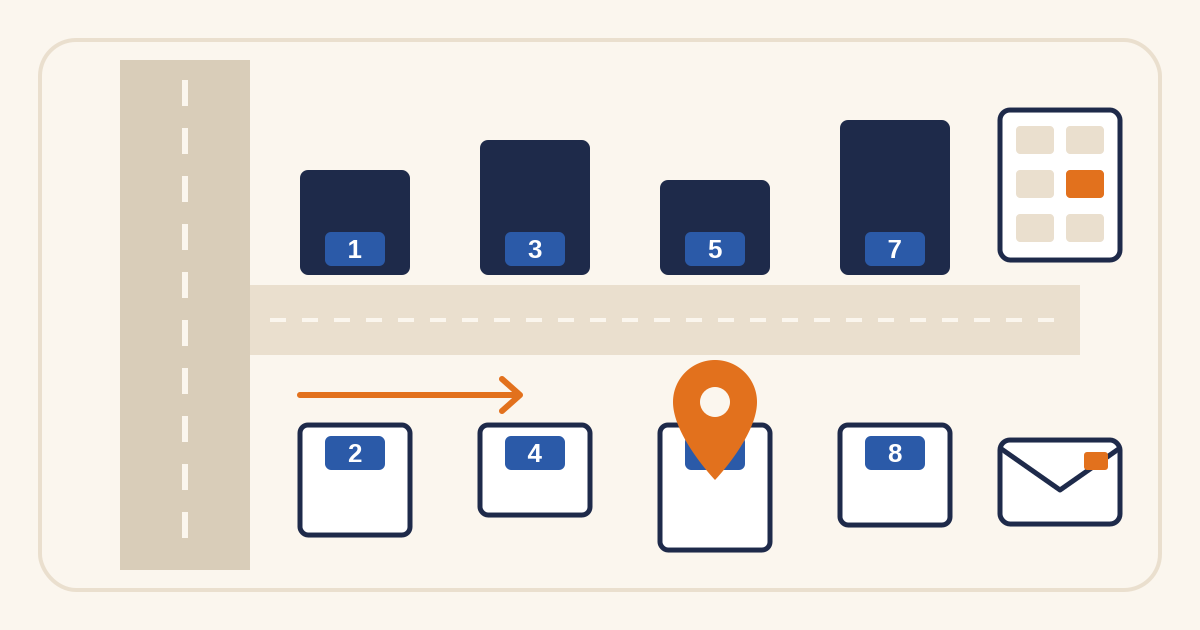
Building numbers run in order from where the road starts, with odd numbers on one side and even numbers on the other. Multiplying the number by 10 gives a rough idea of how many metres it is from the start of the road, so a small number is near the beginning and a large one is towards the end. As you walk, the blue or brown number plates on each building tell you which numbers you are near.
Unit details and postal codes
After the building number, add a comma and the unit details. For an apartment or villa, write the block and unit, such as “○-dong ○-ho”; for a studio building, write the floor and room, such as “○-cheung ○-ho”. Basement floors are written as 지하 or B. A neighbourhood or apartment name is sometimes added in brackets after that as a reference to make it easier to find. If you leave out the unit details, parcels and mail may be left at the entrance or sent back.
Korean postal codes have five digits and have been used in this form since 2015. The first three digits indicate the province or city and the district, and the last two indicate a zone within it. If a document still shows an old six-digit code, use the current one instead. You can find your postal code by entering your road-name address on the government’s address site (juso.go.kr) or on Korea Post’s online site (epost.kr).
Writing your address in English
Korean addresses go from the largest unit (province or city) to the smallest (unit number), but English addresses go the other way, starting with the smallest. Daero, ro and gil are not translated; they are written as they sound. Searching your address on juso.go.kr shows its official English version, so copying that is the most accurate way to receive documents from abroad or fill in English forms.
Most delivery drivers work from the Korean address, so use the Korean version in domestic courier and delivery apps. Use the English version where it will be read abroad, such as for overseas remittances, international shopping or documents for your home country. The table below shows the order for writing the same address in both languages.
| Order | Korean address (largest first) | English address (smallest first) |
|---|---|---|
| 1 | City/province: 서울특별시 | Unit: Room 501 (501-ho) |
| 2 | District: ○○구 | Building number and road: 34, ○○-ro 12-gil |
| 3 | Road and building number: ○○로12길 34 | District: ○○-gu |
| 4 | Unit: 501호 (reference: ○○동) | City/province and postal code: Seoul, 0○○○○ |
Tips for using your address for deliveries, taxis and forms
In courier and delivery apps, search for and select your road-name address, then always enter the unit details (block and unit) separately. If your building has a shared-entrance code, write how to get in or how you want to receive the item, such as “please leave it at the door”, in the delivery request notes. When taking a taxi, showing the destination pinned in a map app or mentioning a nearby large building or apartment complex is far more accurate than saying the address aloud.
The address on bank, phone and government paperwork should match the residence you registered for your alien registration, or problems can arise. When you move, the guidance is to report your change of residence within 15 days of moving, at a community service centre, an immigration office or online on HiKorea. Your registered residence is recorded on your residence card; how the card looks and shows it can vary depending on when it was issued. After reporting, update your address with your bank, phone carrier and delivery apps too.