Which one are you? Workplace vs regional members
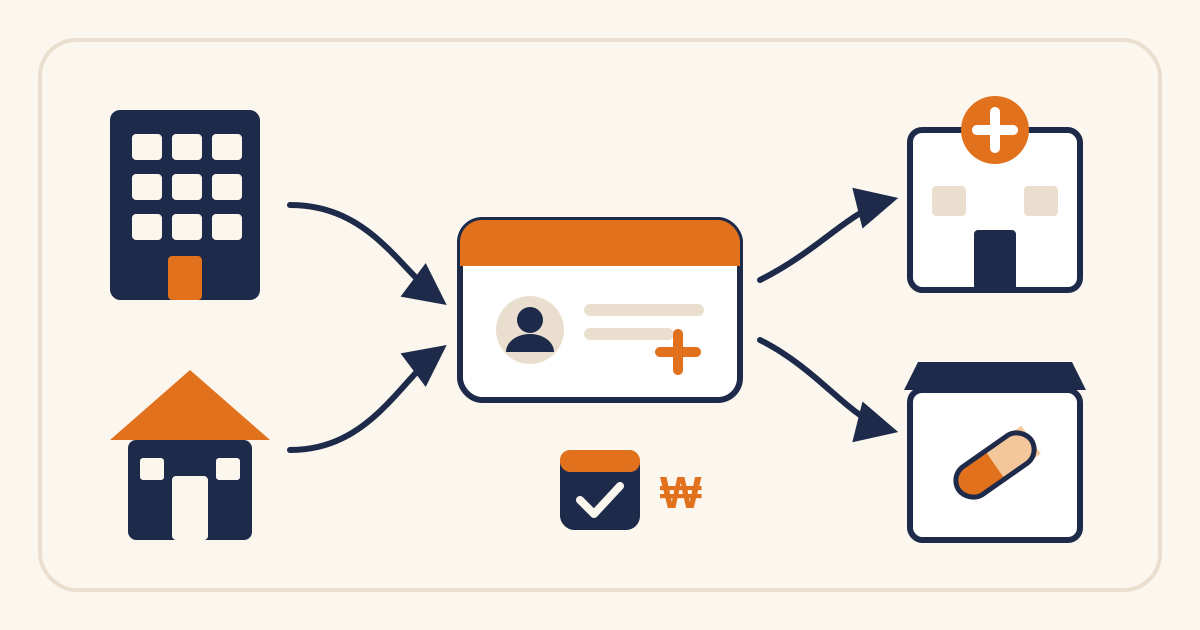
If you are employed by a company in Korea, you normally become a workplace member from your first day of work. Your employer files the enrolment, the premium is split half and half between you and the company, and your share is taken straight out of your salary. Check your payslip for lines labelled health insurance and long-term care.
Registered foreigners who are not employees are, as a rule, automatically enrolled as regional members once they have stayed in Korea for six months (this has applied since July 2019). Some statuses, such as study (D-2), are enrolled from the day of alien registration. The exact start date can depend on your status of stay, so the National Health Insurance Service (NHIS) is the best place to confirm it.
A workplace member who can prove equivalent medical coverage — under their home country’s law or insurance, or through a contract with the employer — may apply to be excluded. Regional members, on the other hand, cannot simply opt out because they hold private insurance, so contact the NHIS first if you are thinking about exclusion.
| Item | Workplace member | Regional member |
|---|---|---|
| Who | People employed by a company | Registered foreigners who are not workplace members |
| Starts | Usually your first day of work | As a rule after six months of stay (registration day for some statuses) |
| Premium | Based on salary, split with the employer | Based on income and assets; the average applies if yours comes out lower |
| How you pay | Deducted from your pay | Bill’s virtual account, auto-debit or the app |
Covering your family
A workplace member’s spouse, children, parents and certain other relatives can be added as dependants if their income and assets are below the set limits and they mainly rely on the member for support. You will need home-country documents proving the family relationship, authenticated by a consulate or with an apostille, plus a Korean translation if required. Limits and paperwork can change, so check with the NHIS before applying.
For foreigners who are regional members, premiums are basically charged per person. If you want a spouse or minor children living with you to be treated as one household, you may need to apply for it separately, so ask the NHIS about household registration if your family lives here with you.
How premiums are set and paid
Workplace premiums are your salary multiplied by the contribution rate. Regional premiums are calculated from income, assets and similar factors, but for foreigners the rule is that if the result is below the overall average, you pay the average. That is why the bill can feel high even when your income is low. Rates and the average amount can change every year, so check your bill or the NHIS website.
Regional premiums can be paid by transfer to the virtual account printed on the bill, automatic bank debit, the NHIS website, or the NHIS app (The건강보험). Foreign regional members pay the next month’s premium in advance, so always check the due date on the bill. When you move, report your new address to immigration so the bills reach you.
When you leave a job, your workplace membership usually ends and you switch to regional membership, so a new bill will arrive. When you leave Korea for good, settle any remaining premiums and ask the NHIS whether anything you overpaid can be refunded.
What happens if you fall behind
If you do not pay, your health insurance benefits at hospitals can be restricted, meaning you may have to pay the full cost of treatment yourself. The rules on restricting benefits for foreigners have recently been revised, so it is safest to ask the NHIS which rules apply now.
Once arrears pass a certain amount, the information is shared with the Ministry of Justice and can count against you when you apply to extend your stay. If the arrears drag on, the NHIS can send demands and eventually seize assets such as bank deposits.
If money is tight and you cannot pay in one go, do not put it off — talk to the NHIS about paying in instalments. If an instalment plan is approved and you keep up with it, the restriction on benefits can be lifted.
Using it at clinics and pharmacies
Show an ID such as your residence card at reception and health insurance is applied. Clinics check identity, so turning up without ID can delay coverage or mean paying the full amount at first. Even with insurance there is a co-payment, and it tends to be higher at larger hospitals.
Some items, such as cosmetic procedures and certain tests or injections, are not covered at all. If you are worried about cost, ask whether insurance applies before treatment. Prescription medicine bought at a pharmacy is covered too.
In the NHIS app you can check and pay premiums, view your treatment history and issue a certificate of coverage. If Korean is hard for you, use the NHIS foreign-language phone line. The difference between local clinics and big hospitals, and what to do when you need medicine at night, are covered in our “When you are sick” guide.