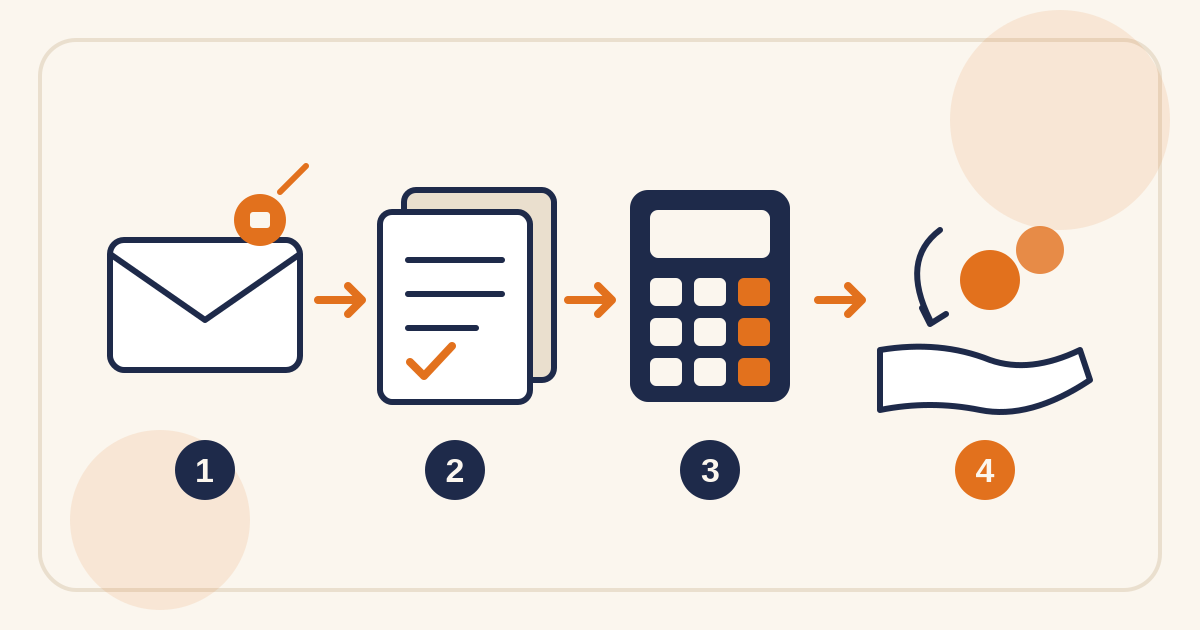
Why tax comes out of your pay first
When a Korean employer pays your salary, it deducts income tax and local income tax in advance and pays them to the government on your behalf. This is called withholding. The amount is an estimate based on a standard table, so it is usually a little different from the tax you actually owe. The year-end settlement early the following year corrects that difference.
Your payslip will also show social insurance contributions, such as the national pension, health insurance and employment insurance. These are separate from tax, so do not mix them up. Keep your payslips, even as photos on your phone — they are very useful later if you need to check unpaid wages or a tax problem.
Year-end settlement — squaring up a year of tax through your employer
The year-end settlement recalculates your real tax by adding up what you earned last year and what you spent on deductible items. Your employer usually collects documents and processes it in January–February. If you paid too much you get a refund; if too little you pay the rest. The result is usually reflected in your February or March pay, but this varies, so ask the person in charge at work.
For foreigners, the deductions you can claim depend on whether you count as a resident or non-resident for tax purposes. This is judged by looking at how long you have stayed, your job, and where your family and assets are, so if you are not sure which you are, check with your employer or the tax helpline. Some foreign workers can also choose a single flat tax rate instead of claiming deductions. Which option is better differs from person to person, so compare them using the National Tax Service’s year-end settlement guide for foreigners.
What documents do you need, and where do you get them?
In the simplified year-end settlement service on Hometax (the National Tax Service website) and Sontax (its mobile app), you can download in one go the data that institutions have already sent in — insurance premiums, medical bills, education costs, card spending and so on. It usually opens around mid-January each year, and to log in you need your alien registration number and a way to verify your identity (such as a financial certificate or a simple authentication app).
Some things do not appear in the simplified data. To list family members living abroad as dependants, you may need to submit separate proof of the family relationship along with a translation, and the monthly rent deduction requires conditions to be met plus proof such as your lease and transfer records. The table below sums up what to check before you hand documents to your employer.
| Item | Where to check or get it | Watch out for |
|---|---|---|
| Insurance, medical bills, education, card spending | Simplified service on Hometax or Sontax | Some clinic or optician receipts may be missing — keep them separately |
| Dependants living abroad | Family relationship documents from your home country, with translation | Check the age and income conditions and required proof with your employer or 126 first |
| Monthly rent | Your lease and rent transfer records | Conditions apply (housing type, income, etc.), and the address may need to match your registered residence |
| Income from a previous job | Withholding receipt from your previous employer (also viewable on Hometax) | If you do not give it to your new employer, you may have to file yourself in May |
When you must file yourself in May
If the company settlement does not cover everything, you file a comprehensive income tax return for last year’s income yourself every May (if the last day falls on a weekend, the deadline moves to the next weekday). Examples: you were paid by two or more employers in a year and the income was not combined; you quit partway through the year and did not take a new job; you had freelance-type income with 3.3% taken off; or you want to claim deductions you missed at the year-end settlement.
You can file on Hometax or Sontax, and in many cases you only need to check a return the National Tax Service has already filled in. After finishing the income tax return, a button takes you to the local income tax screen (Wetax), so make sure you complete both. If it is hard to do alone, many tax offices open help desks in May, so contact your nearest tax office in advance.
When you quit your job or leave Korea
If you quit partway through the year, your employer settles the tax for the period you worked when it pays your final salary. Be sure to get your withholding receipt at that point — you will need it for your next employer or for filing in May. Any refund goes into your own account, so leave your employer the correct account number and contact details.
If you are leaving Korea for good, make sure your taxes are settled before you go. If you have income you must report yourself, you may need to file before departure, so once your departure date is set, it is safest to ask your employer and the tax helpline (126) how to handle it. If you are waiting for a refund, do not close your Korean bank account straight away.
Separately from tax, depending on your visa status and nationality, you may be able to get your national pension contributions back as a lump sum when you leave. Check eligibility and how to apply with the National Pension Service (1355).
Where can you ask?
The National Tax Service consultation centre can be reached anywhere in Korea at 126 (no area code) during weekday office hours. The NTS also runs an English helpline for foreigners (1588-0560) and an English website, and publishes a year-end settlement guide for foreign workers in several languages each year. Check that year’s guide to see whether a Thai version is available.
Text messages saying “you have a tax refund” that ask you to tap a link or install an app are very likely scams. Only check or file your taxes on the official Hometax website and the official Sontax app. You can also browse job listings on K-lifeon’s jobs page.